
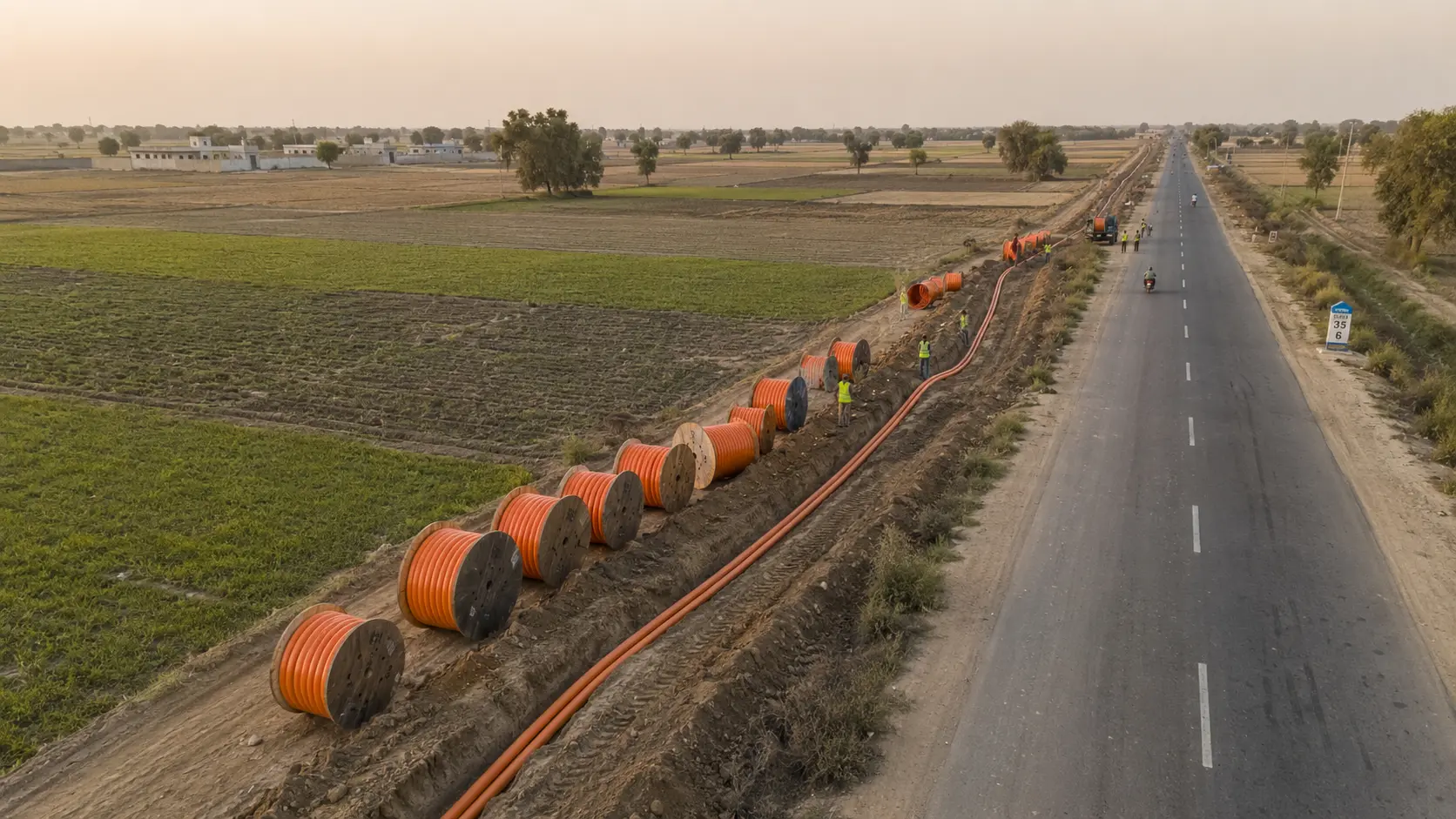
Muzaffargarh, Punjab, Pakistan
Southern Punjab Digital Backbone
Project Overview
The Muzaffargarh Optical Fiber Network is a major telecommunications infrastructure initiative designed to extend high-capacity connectivity throughout underserved areas of Southern Punjab.
The project established approximately 699 kilometres of optical fiber infrastructure, connecting 91 Union Councils across Muzaffargarh, Kot Addu, Alipur and Jatoi.
With infrastructure capable of supporting 10 Gbps backhaul and future upgrades toward 100 Gbps, the network provides a scalable foundation for broadband services, mobile backhaul, enterprise connectivity and digital services.
At a Glance
Our Scope
The infrastructure program covers the deployment and commissioning of a regional fiber backbone designed to provide reliable high-capacity connectivity across communities that previously had limited telecommunications infrastructure.
- Optical fiber route deployment
- Fiber cable installation
- Network node deployment
- High-capacity backhaul
- Mobile BTS backhaul connectivity
- Network testing and commissioning
- Infrastructure designed for future capacity expansion
Network Architecture
The project uses a high-capacity optical backbone to connect regional network nodes and provide transport capacity for downstream telecommunications services.
The use of 48-fiber cable provides significant additional capacity for future network expansion while allowing operators to support multiple services over the same regional infrastructure.
Building Southern Punjab's Digital Future
The project demonstrates how regional fiber infrastructure can become the foundation for wider digital transformation.
Beyond basic internet access, high-capacity fiber provides the transport infrastructure required by mobile operators, broadband providers, businesses, educational institutions, healthcare facilities and government services.